Home › Services
Concrete walkways and steps for sloped Knoxville lots
On a flat lot a walkway is simply a path. On the hillside lots common around Knoxville, it is a small piece of engineering that has to carry people safely up and down a grade in rain, leaf fall and the occasional icy morning, while keeping stormwater from following the same route toward the front door. Safety and drainage come first here; appearance follows.
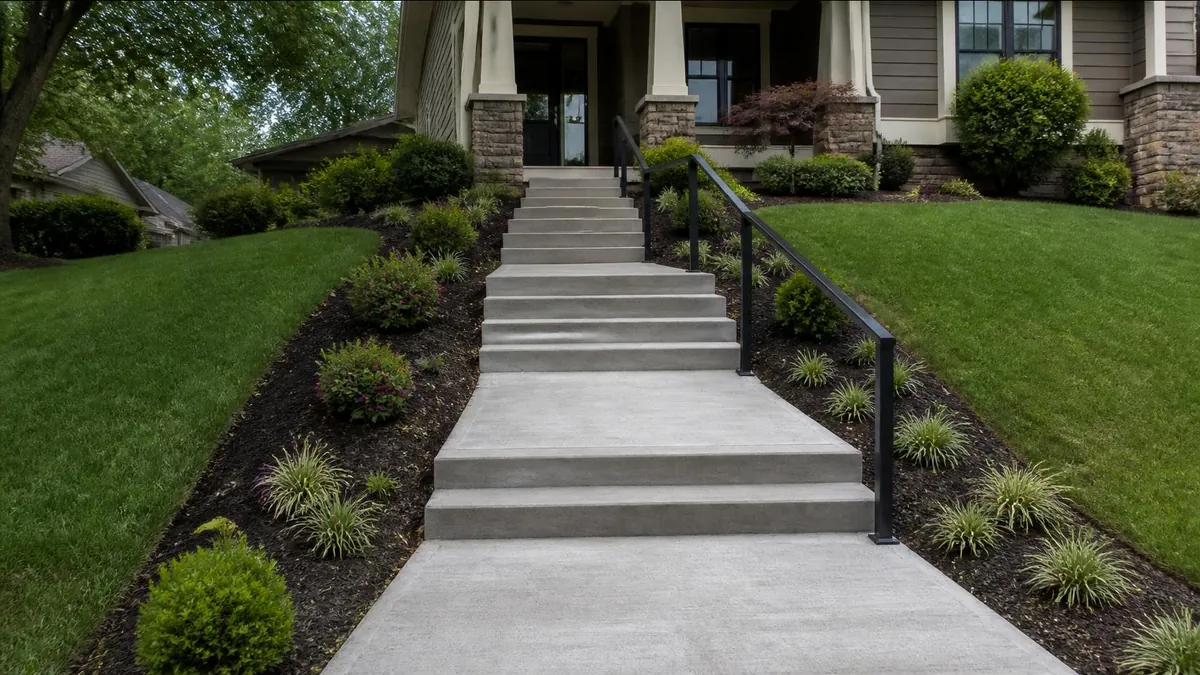
Why hillside walks and steps need extra planning
The ridges and valleys of East Tennessee mean many homes sit above or below the street, with the driveway taking one route and the front walk another. Every foot of height between the car and the door has to be handled either by a sloped path, by steps, or by a mix of both. How that change in grade is split up decides whether the walk feels easy or awkward.
Water follows the same logic as people. A walk laid straight down a slope becomes a channel in every storm, carrying silt and mulch onto the porch or the drive. A walk cut across the slope can act like a dam, holding water against its uphill edge until it soaks under the concrete. A good design looks at both how people move and how rain moves before any forms go down.
Front walks, side paths and garden routes
The front walk is the one visitors use, so it deserves a comfortable width for two people or a person with a bag of groceries, gentle curves only where they help, and a finish that is easy on the eye from the street. Side paths to gates, trash cans and the back yard see less traffic but often carry more water, since they tend to run along the house where roof runoff lands.
For any walk, the surface should tilt slightly to one side, called cross slope, so rain drains off the edge rather than lying in a sheet down the middle. The low edge should empty onto grass or gravel, not against the foundation or into a planting bed that already stays wet. Along the house, keep the walk a little below the siding and away from basement windows.
Steps and landings on a grade
Concrete steps on a slope are usually formed in place and tied to a footing or a thickened base so they do not slide or tip over time. The most important safety detail is consistency: every riser in a flight should be the same height and every tread the same depth. People set their stride by the first two steps, and one odd step is what catches a foot, especially at night or while carrying something.
Landings break a long climb into manageable flights and give a place to pause, open a gate or turn a corner. They also need to drain, since a flat landing that holds water becomes an ice rink in January. Rules on step dimensions, landings and railings can apply to residential work, and they vary by jurisdiction, so check with the City of Knoxville or the county building office before the design is final.
Handrails and where they help most
A handrail is one of the simplest safety upgrades on a hillside set of steps. It helps older visitors, children, anyone carrying packages, and everyone on a frosty morning. Whether one is required depends on the number of steps and local code, which the homeowner should confirm with the city or county, but many owners choose to add one even where it is optional.
Planning for a rail before the pour makes it stronger and neater. Posts can be set in sleeves cast into the concrete or anchored to thickened areas, rather than drilled later into a thin step edge that may chip or crack. Think about which side people naturally reach for, whether both sides are needed on wider steps, and how the rail will meet the porch or the landing at the top.
Traction finishes and winter ice on north-facing slopes
A walk should feel sure underfoot when wet. A medium or heavy broom finish, brushed across the direction of travel, gives good grip; exposed aggregate is another strong choice. Smooth troweled walks and glossy sealers look nice in dry weather and turn treacherous in rain, leaf litter and frost. Step nosings are the most worn and most slippery spot, so they deserve extra texture.
Knoxville winters are mild by northern standards but bring plenty of freezing nights, and a walk on the shady north side of a house or under evergreens can hold ice long after the street clears. Plan the slope so meltwater drains off rather than refreezing on the path. For de-icing, sand or a gentle product is kinder to young concrete, since salts accelerate scaling, especially during the first winter.
Frost, settlement and cracking at the base of steps
The spot where a flight of steps meets the walk below is a common place for trouble. Water running down the steps lands there, soaks into the clay, and softens it. Over time the bottom step or the first walk panel can sink, leaving a lip that trips people, or a gap that pulls away from the stair. Freeze-thaw cycles and loosely backfilled soil beside the stair make it worse.
- Look for a gap opening between the bottom step and the walk, or a panel tilting toward the stair.
- Check whether water ponds at the foot of the flight after rain.
- Notice any rise or drop between walk panels that catches a shoe edge.
- Watch for soil washing out from under the side of the steps.
- Ask how a new design will carry water away from that landing and what the base beneath it will be.
Tying new work into porches and driveways
Walks rarely stand alone. They meet a porch slab, a stoop, a driveway or an existing sidewalk, and each connection needs an isolation joint so the pieces can move separately. Pinning a new walk rigidly to an old porch often cracks one or the other. Where the new surface meets the driveway, it should sit flush enough to avoid a trip edge while still draining properly.
Height is the tricky part at a porch. If the new walk raises the ground level, the top step may become shorter than the rest; if it lowers the ground, the step grows taller. Either change breaks the even rhythm that makes stairs safe. A careful contractor measures the existing porch and plans the grade so step heights stay consistent, or suggests rebuilding the stoop at the same time.
Public sidewalks and judging a walkway quote
If your project touches the public sidewalk along the street, or the strip between it and the road, that area may fall under the city or county rather than the homeowner alone. Who is responsible for repairs, whether a permit is needed and what specifications apply depend on the jurisdiction, so check with the City of Knoxville or Knox County, or your own town, before planning work there.
For the private walk and steps, a sound quote describes the base depth and compaction, slab thickness, where joints will fall, how steps will be supported, the drainage direction, the finish and any rail provisions. Vague line items such as pour new walk leave too much room for shortcuts. Ask how the contractor plans to handle the transitions at the porch and the drive, since those spots decide how well the walk ages.
Concrete walkways and steps for sloped Knoxville lots — common questions
How wide should a front walkway be?
There is no single right width, but a main front walk is usually made comfortable for two people side by side or one person carrying bags. Narrow walks feel cramped and push people onto the grass, which wears ruts along the edges. Side paths to a gate or trash area can be narrower. Mark the outline on the ground first and walk it with a friend before deciding.
What makes concrete steps safe to use?
Consistency is the biggest factor. Every riser in a flight should be the same height and every tread the same depth, so people do not misjudge a step. A textured finish on the treads and nosings, good drainage so water and ice do not collect, and a sturdy handrail all add safety. Local code may set specific dimensions, so check with your city or county before building.
Do I need a handrail on my new steps?
It depends on the number of steps, the total height and the rules where you live, so confirm with the City of Knoxville or your county building office. Even where a rail is not required, many homeowners add one on hillside steps because it helps in rain, frost and darkness. Planning the rail before the pour allows sleeves or anchors to be cast in for a stronger connection.
Why does the bottom step keep pulling away from my walk?
Usually because the soil at the foot of the stair is getting wet and losing support. Water running down the steps lands in that one spot and soaks the clay, and freeze-thaw movement adds to it. The walk panel settles, opening a gap or a trip edge. Fixes range from slab lifting if the concrete is intact to rebuilding the base with better drainage.
What finish gives the best grip on a sloped walkway?
A broom finish brushed across the direction of travel is the common choice for sloped walks, because the ridges catch the sole of a shoe. Exposed aggregate also grips well and hides dirt. Avoid a smooth steel-troweled surface or a glossy sealer on any path that slopes or stays shaded. Ask for extra texture on step edges, where feet land and slip most often.
Can I replace the public sidewalk in front of my house?
Possibly, but that strip is often under the control of the city or county, which may set its own requirements for permits, thickness and finish, or handle repairs itself. The rules vary, so contact the City of Knoxville, Knox County or your own town before hiring anyone. A contractor should also ask this question before quoting work that reaches past your property line.
How soon can people use new concrete steps and walks?
Walking on a new path is generally okay within roughly two days, though cool weather or a slower mix can stretch that. Keep wheelbarrows, bikes and heavy deliveries off for about a week so edges do not chip. In late fall, avoid de-icing salts on new concrete through the first winter, since young surfaces are more prone to scaling. Ask the contractor for curing and care instructions specific to your pour.
Talk through your project
Start with the address, what you want poured or replaced, rough dimensions, and a few photos of the area and any existing concrete.
Related work
Concrete Driveways
New driveways, extensions and full tear-out and replacement.
Concrete Patios
Backyard patios and pads that shed water away from the house.
Stamped & Decorative Concrete
Pattern, color and exposed aggregate, and what each asks of upkeep.
Garage, Shed & RV Slabs
Pads sized and reinforced for what will actually sit on them.
Concrete Repair & Replacement
Deciding between patching, lifting and tearing out a failed slab.