Home › Services
Concrete driveways judged by the base and the drainage
Most people judge a new driveway by how smooth and clean it looks on the day the forms come off. That tells you very little. Whether a concrete driveway in Knoxville stays flat and crack-controlled for decades depends on two things you cannot see once it is poured: what the slab is sitting on, and where the water goes when a summer thunderstorm sends a sheet of runoff down the hill. This page walks through each decision in the order a good contractor makes it.
Why the ground under a Knoxville driveway decides its lifespan
Much of Knox, Blount and Loudon counties sits on clay-rich residual soil, the familiar red clay that sticks to boots. It swells when it gets wet, shrinks and cracks open in a dry August, drains slowly, and loses much of its strength when it stays saturated. Concrete is strong in compression but has little tolerance for being bent, so a slab over clay that moves unevenly will crack wherever the support changes.
Newer subdivisions add a second problem. Lots graded on the ridges and hillsides of the Ridge-and-Valley often have fill pushed against the house and across old low spots. Fill that was not compacted in thin layers keeps settling for years. The strip beside the garage, where the foundation was backfilled, and any trench for a water or sewer line are the usual places a driveway sinks first.
A driveway quote that says nothing about the subgrade is quietly assuming the ground is fine. Ask the contractor what they expect to find, what they will do if they hit soft spots, and whether any unsuitable material will be dug out and replaced.
Base preparation: the work that disappears under the pour
A typical sound approach is to strip topsoil and organic material, proof the subgrade by driving or rolling over it to reveal soft areas, then place a layer of crushed stone and compact it with a plate compactor or roller. Stone that is dumped and raked but never compacted will consolidate later under the weight of the slab and your vehicles, and the concrete follows it down.
Watch the grade as well as the stone. The finished base should already carry the slope the driveway needs, so the concrete is an even thickness everywhere rather than thin at the high spots. On a drive that runs downhill toward the house or garage, the plan should show how water will be turned aside before it reaches the door, whether by crowning the slab, pitching it to one side, or adding a trench drain.
Thickness, reinforcement and where the heavy vehicles sit
Residential driveways are commonly poured around four inches thick. That is often adequate for cars and light trucks on a well-built base. It is worth thickening the areas that carry more: the spot where a work truck, a delivery van or a camper parks every night, the turnaround where tires scrub while turning, and the outer edges, which have less support than the middle of the slab.
Reinforcement comes in three common forms. Welded wire mesh and rebar help hold cracked pieces tightly together so they do not separate or shift. Synthetic or steel fibers mixed into the concrete help control small shrinkage cracks throughout the surface. None of them prevents cracking outright, and steel only helps if it ends up near the middle of the slab. Mesh laid on the ground and walked into the stone during the pour does almost nothing. Ask how the steel will be held up, such as on chairs or blocks.
Ask about the mix too. For a surface that sees freezing nights and road salt carried in on tires, air-entrained concrete is the common choice because the tiny bubbles give freezing water room to expand.
Control joints on long and sloped driveways
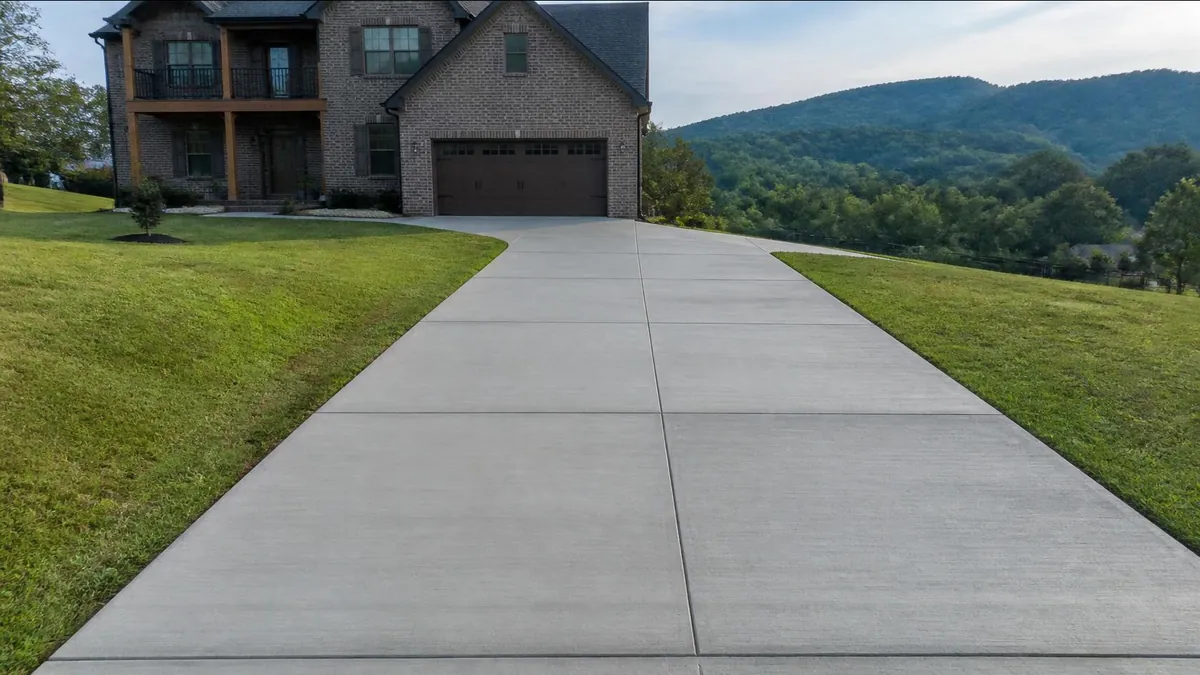
Every slab loses volume while it dries and swells or contracts with the weather, so some cracking is certain. Control joints are grooves cut or tooled into the surface so those cracks form in straight, planned lines instead of wandering across the slab. A common guideline puts joints at intervals of two to three times the slab thickness in feet, which for a four-inch driveway works out to roughly eight to twelve feet.
Long, narrow drives on hillside lots need joints across the width at regular spacing and, where the drive is wide, a joint down the center. Panels should be close to square; long skinny rectangles tend to crack across the middle. Joints belong at inside corners, where the slab meets the garage floor, around drain boxes, and where the width changes. If sawcut joints are planned, they need to be cut soon after the concrete can bear the saw. Cutting a day too late is a classic reason a brand-new driveway shows random cracks.
The apron and the transition to the street
The apron is the section between your driveway and the road. It often lies partly or fully within the public right-of-way, and it takes the hardest hits: turning tires, the drop at the gutter line, and water running along the street. Rules for aprons, curb cuts and work in the right-of-way vary between the City of Knoxville, the surrounding counties and individual towns, and many subdivisions add their own requirements.
Before you sign, check with the city or county that has jurisdiction over your street, and with your HOA if you have one, about what approval is needed for the apron and any change in width. A good quote will say who is responsible for arranging any required approval and how the joint between the new apron and the street edge will be finished so water does not sit in it.
Widening a driveway or adding a parking pad
Extensions are popular on narrow drives where two cars cannot pass. The new concrete needs to be tied to the old slab so the two sections move together vertically. A common method is drilling into the edge of the existing slab and setting smooth steel dowels that let the joint open and close without letting one side drop. Without that connection, the new section often settles slightly and leaves a lip to trip over or catch a snow shovel.
Expect the new concrete to look different at first. Fresh concrete is lighter and more uniform than a slab that has weathered for years, and it will not fully blend even when the finish is matched carefully. Some homeowners choose to sawcut a clean line and replace a larger area so the color change lands at a sensible joint, rather than in the middle of the drive.
Curing, first use and sealing against de-icers
Concrete gains strength as it cures, which depends on keeping moisture in the slab. In a Knoxville summer, sun and wind can dry the surface too quickly and weaken it, so ask whether the contractor will apply a curing compound or keep the slab damp. Foot traffic is usually fine after a few days. Cars need longer, and heavy trucks longer still, so plan deliveries and moving trucks around the pour and ask the contractor for their specific timing.
Winter is hard on the top of a new slab. De-icing salt dripping from cars soaks into the surface and adds stress on every freeze. A penetrating sealer applied once the concrete has cured, then renewed periodically, helps keep water and salt out. Avoid putting de-icers directly on a first-winter driveway; sand gives traction without the chemical attack.
How to compare two driveway quotes line by line
Two quotes for the same driveway can differ widely because they describe different jobs. Lay them side by side and check whether each one answers the same questions. A vague quote is not necessarily a bad contractor, but it leaves you no way to hold anyone to a standard.
- Demolition and haul-off: is removal of the old driveway included, and how deep will they dig?
- Subgrade: what happens if soft clay or loose fill is found, and is that priced separately?
- Base: type of stone, how thick, and how it will be compacted.
- Thickness: overall, and where it will be thickened for heavy parking or edges.
- Reinforcement and mix: mesh, rebar or fibers, how steel is supported, and whether the mix is air-entrained.
- Joints: sawcut or tooled, spacing, and when sawcutting will happen.
- Drainage: slope direction, and how water is kept away from the garage and foundation.
- Apron and approvals: who checks the city, county and HOA requirements.
- Finish, curing and sealing: broom texture, curing method, and whether a sealer is included.
Concrete driveways judged by the base and the drainage — common questions
How thick should a concrete driveway be in Knoxville?
A four-inch slab laid on well-compacted crushed stone is a common residential standard and usually handles cars and pickups. If a camper, box truck or loaded trailer will park regularly, ask for those areas to be thickened, along with the outer edges. A thicker slab over a poor base will still fail, so compare base preparation before comparing thickness alone.
Why do new driveways crack even when they are done well?
All concrete shrinks as it dries and moves as temperatures change, and that movement creates stress that eventually has to release somewhere. Control joints give the crack a planned, straight place to form, usually hidden in the bottom of the groove. A crack inside a joint is normal. Random cracks across panels usually point to joints that are too far apart, cut too late, or a base that moved.
How long before I can drive on a new concrete driveway?
Walking on it is usually fine within a few days, but vehicles should wait longer while the concrete gains strength. Heavy trucks need even more time. The right wait depends on the mix, the weather and how well the slab is cured, so ask the contractor for a specific date and put a barrier across the entrance so visitors and delivery drivers do not pull in early.
Do I need approval to replace the part of my driveway at the street?
Possibly. The apron often sits in the public right-of-way, and requirements for work there differ between the City of Knoxville, the counties and nearby towns. Subdivisions with an HOA may have their own rules about width, finish and appearance. Check with the local government that maintains your street and with your HOA before work starts, and ask the contractor who will handle any paperwork.
Can a contractor widen my existing driveway so it matches?
The new section can be tied to the old one structurally with drilled dowels so both sides stay level. Matching the appearance exactly is harder, because weathered concrete has a different color and texture than fresh concrete. Expect a visible difference at first that softens over time. Placing the seam along a straight joint line usually looks more intentional than trying to hide it.
Should a new concrete driveway be sealed?
Sealing is a sensible step for driveways that see winter salt dripping off cars. A penetrating sealer applied after the slab has cured helps limit how much water and de-icer soaks into the surface, which reduces flaking over time. It is maintenance, not a one-time fix, and needs renewing every few years. Ask whether the quote includes it and when it should be applied.
What should I do if water runs down my driveway into the garage?
Raise this before the new driveway is designed, because it is far easier to fix in the grading than afterward. Options include pitching the slab to one side, adding a slight crown, or installing a trench drain across the drive near the garage that carries water to a safe outlet. Ask each contractor to explain where the water will go and show it on a sketch.
Talk through your project
Start with the address, what you want poured or replaced, rough dimensions, and a few photos of the area and any existing concrete.
Related work
Concrete Patios
Backyard patios and pads that shed water away from the house.
Stamped & Decorative Concrete
Pattern, color and exposed aggregate, and what each asks of upkeep.
Walkways & Steps
Sidewalks, front walks and steps on sloped East Tennessee lots.
Garage, Shed & RV Slabs
Pads sized and reinforced for what will actually sit on them.
Concrete Repair & Replacement
Deciding between patching, lifting and tearing out a failed slab.